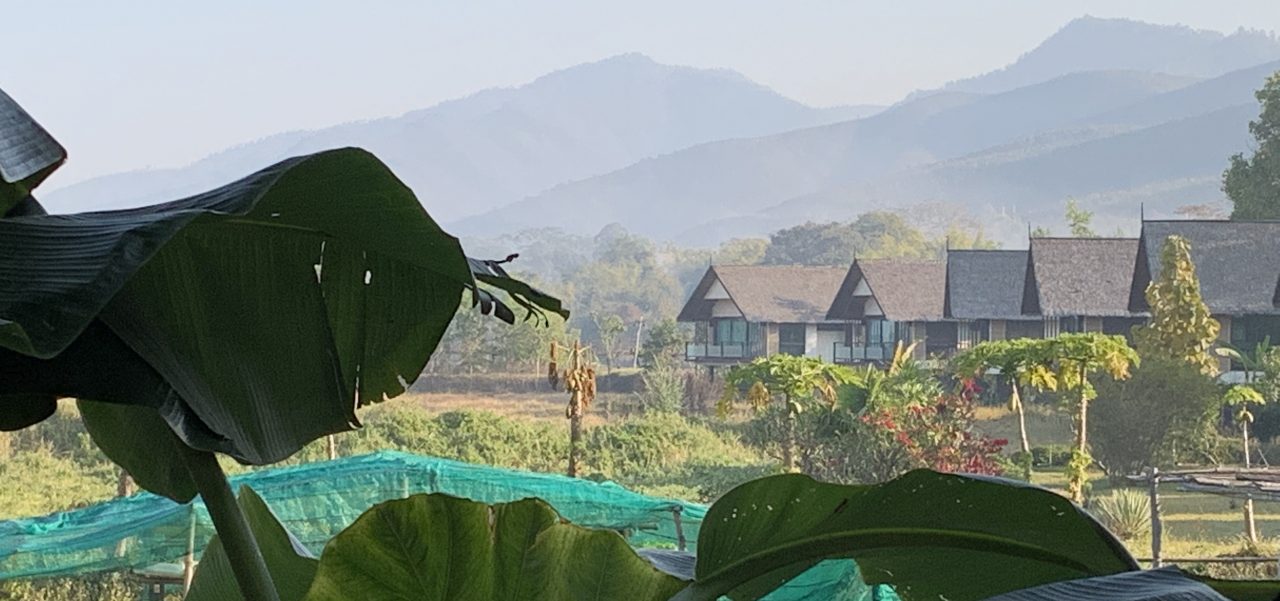
On our second day in Chiang Mai we split up. Larry takes a bike ride through farm communities on the outskirts of Chiang Mai. Cornelia takes a cooking class in Northern Thai cooking.
A trip through the fruits and vegetables – So far our contact with produce has been in the fresh markets. Now I have a chance to ride through farm country and learn about some of the produce. Our guide for the day is AJ, who is extremely knowledgeable about sustainable agriculture and good diet and is walking evidence of the benefits of exercise and healthy eating.
We stop here and there at fields of cauliflower, bok choy, and other vegetables. We see fruit orchards as well as random fruit trees — star fruit, tamarind, and others interspersed with rows of vegetables. Finally, we stop on a dike overlooking a huge area of sticky-rice fields.


A couple of observations: First, we are riding around very fertile fields, with a sophisticated irrigation system that draws water from a nearby river and channels it through a series of irrigation canals to the fields. This is the dry season, and in three-plus weeks of travel we have yet to see a raindrop. Yet, I am sticking my figure in moist soil – a combination of a little moisture condensation and a morning sprinkling from the irrigation ditch.

Second, they practice very disciplined cropped rotation with the vegetables (not the rice), so no field has the same vegetable growing in it two plantings in a row. In a small area, neighboring families share the harvest from their fields – and what else is produced will go to the fresh markets in town.
Third, rice is an amazingly difficult crop that takes skill and experience and a lot of hard labor to grow. In Northern Thailand and Laos, sticky rice is the preferred crop, but there other varieties that are grown as well. Rice seedlings are grown from seed in one location and then separated and transplanted spaced apart in very neat rows in the rice paddies. The paddies are flooded for planting. In most places, farmers can get in two crops a year – in some places three. When ripe, the rice stalks are cut and the rice is beaten off the stalks.

We stop to see a family who have built a new concrete house but also use their old teak house. Someone from the city has just built a fancier concrete house behind them (and there seems to be a little resentment about the new people coming into the area). The old teak house is built on pilings with open space below for cool breezes. The chickens roost under the house. The second story houses the bedrooms and kitchen. Teak is resistant to termites and an excellent, although increasing rare and expensive, building material.


We stop again for a small roadside family business that makes and sells the ideal quick lunch-in a box. First, they find bamboo at just the right growth stage for this product and cut it just below a knot to use the knot as a bottom to the vessel. The bamboo is hollow and makes a good cooking and carrying vessel. Sticky rice is soaked overnight in either water or coconut milk. It is then packed into the bamboo tube. A variety of flavorings are mixed in with the rice and the end is packed tight with rice. The tubes are cooked on a grill and the charred bamboo exterior is pealed off, leaving a thin skin of the interior bamboo lining. People buy the tube and peel back this lining, eating the flavored sticky rice with their fingers.. One favorite item we try is sweet — flavored with Perillo seed mixed with coconut-milk-soaked rice. Another item is savory – plain sticky rice with black beans.


We end our ride with a stop for lunch at a small roadside eatery. The dish of the day is Khao Soi — a flavorful chicken curry noodle soup that is a regional specialty. It comes with red onion, pickle, and fresh lime to be added. A truly spectacular dish.


North Thailand Cooking – Cornelia has the opportunity to take a class in cooking Northern Thailand dishes at the Baal Hongnual Cooking School. Teacher Kwan starts the class with a visit to the morning market to pick up fresh lemongrass, baby corn, small eggplants, tofu, snow peas, and chili peppers.

Wearing their chef’s hats and aprons and positioned at their individual stations each with a wok, a wooden cutting board, a sharp chef’s knife, and fresh ingredients, Cornelia and her 5 colleagues prepare an array of dishes, including spring rolls, “Tom Kha Khai” (chicken and cocoanut milk soup), and one of three “Gaeng” (chicken curries): Masaman (yellow), Kiao Waan (green), or Daeng (red). The curries had chicken and eggplant, used cocoanut milk, curry paste, basil, kafir lime and kafir leafs. Extra spring rolls will be donated to the monks, the chefs eat the rest, and look forward to recreating these dishes at home if the right ingredients can be found.


The White Temple — We leave in the afternoon for Chiang Khlong on the Laos border for the night in preparation for crossing into Laos in the morning. Along the way we stop in the late afternoon in Chiang Rai at Wat Rong Khun, known as the White Temple. This temple is a tour de force by a noted Thai painter turned architect — it is both incredibly creative and bizarre — an amazing mind-bending experience unlike any other Buddhist temple.


The message in the temple is unique and almost cult-like. Begun in 1997, parts of the temple and other buildings are still under construction – and the mastermind behind this is still raising money. Part of the genius of the temple is the array of money-raising concepts built into the design —for example, little silver paper pendants people write messages on for $1 — thousands of which are hanging to form the ceiling of the covered walk way. When finished, the creators intent is to recruit monks to live in the monks quarters here.

Chiang Khlong — We arrive at this Thai border town late in the day and get ready for our morning crossing into Laos.