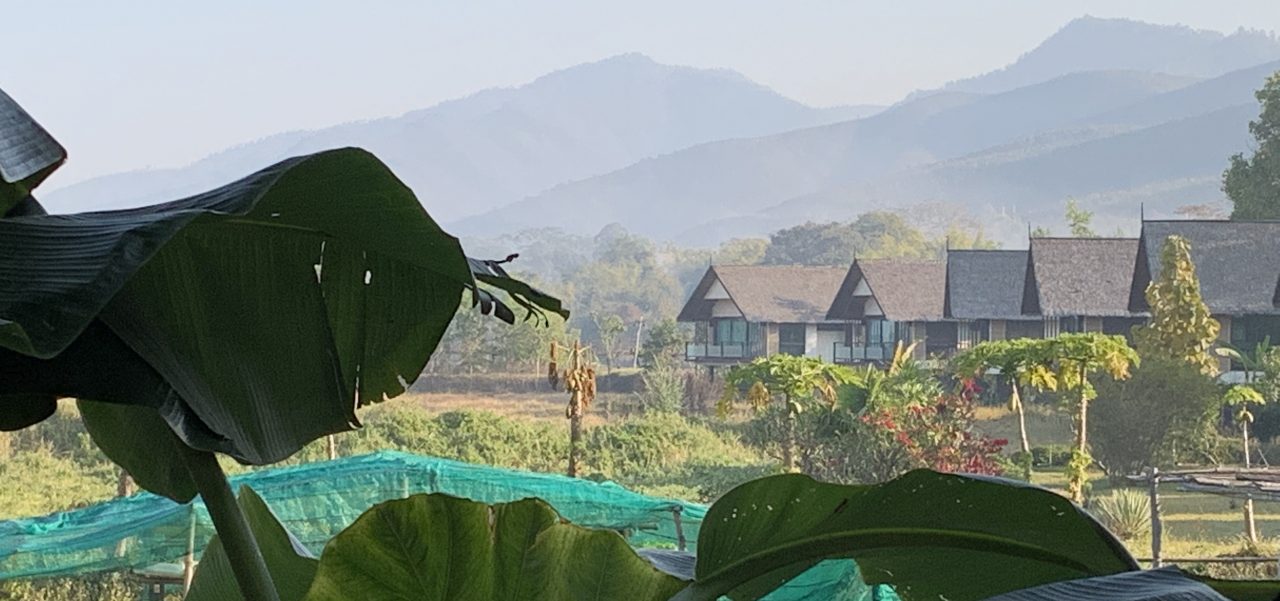
Pakbeng — the slowboats going between the border crossing at Huay Xai and Luang Prabang stop for the night at the small town of Pakbeng that is the halfway point. The town is largely a string of “guest houses” and restaurants that cater to the flow of visitors coming downstream on the slowboats. Ethnic groups in the area are Khmu and the Hmong.


Pakbeng just got electricity back 5 years ago after a dam failure that cut off their electricity for 7 years. Many small towns that have not had electricity are adopting solar power. Cooking in Pakbeng is still over wood fires — typically outdoors in front of the house — where meet is grilled on a skewer or stir fried in a wok that is set on stones.

Morning starts early — Farmers and sellers arrive with their produce at the market starting at 4:30 am and the market opens from 5 am to 8 am. The sellers then return home to work their farms in the mornings. Work slows down in the heat of the afternoon. The market re-opens from 4 pm until 6 pm.


As the town awakens, the chants from the Buddhist Temple can be clearly heard over loudspeakers.

Children go to primary school in the village, but have to go to another village for secondary school — children have to board in or move to the village (family may build a small home in that village and move there. Then have to move to a city for high school. Govt says children have to finish high school — marriage has to be 18 or older – don’t recognize marriage if younger.

After the morning market closes, the town streets get busy with shopkeepers opening their stores, food sellers offering breakfast on the streets, whole families getting to work and school on motorcycles, and monks walking the streets to collect alms.


Second day on the river — we reboard our boat for another day on the Mekong River. The loading area is busy with groups getting to their boats and individual travelers waiting for the scheduled longboat shuttle to arrive.

As we head out on the boat, the river becomes really narrow in spots — threading the needle between rock outcroppings — followed by areas where the river widens and the current is less noticeable – and then the river narrows again with a lot of exposed rock and strong rapids that rock the boat.


As we proceed downriver further, we see more boat traffic – especially commercial and tour boat activity.


A Second Great Lunch — It is hard to beat yesterday’s lunch, but today’s is close: Laap (a Lao salad of minced chicken, mint, and hot peppers), fried green beans, rice vermicelli with ginger and chicken, and a vegetable and chicken curry. Followed by a reprise of mango and sticky rice (welcome leftovers from yesterday).

The Last Leg — The surrounding terrain steepens as we draw closer to Luang Prabang. We pass under the bridges that China is constructing to carry the high-speed train they are building to connect Laos with China.


We come to shore briefly to tour the Pak Ou (Ou Caves). In the tumultuous years of Thai, Burmese and Laotian conflict before the French established colonial rule in this area, the important Buddha images in Luang Prabang were hidden in the Pak Ou Caves. They have since been removed and repatriated across the river, and the caves adorned with thousands of Buddha statutes.


Finally we reboard the boat for a brief jaunt across the river to Luang Prabang, where we settle in for a few days.
The Atkins’ spectacular pictures bring back wonderful memories, We lived in Luang Prabang in 1968-69. In those years the hostilities precluded traveling on the river between Pak Ou and Ban Huay Xai. One could only travel by plane. In 2003 we returned to Laos and took the same two-day boat trip down the river.