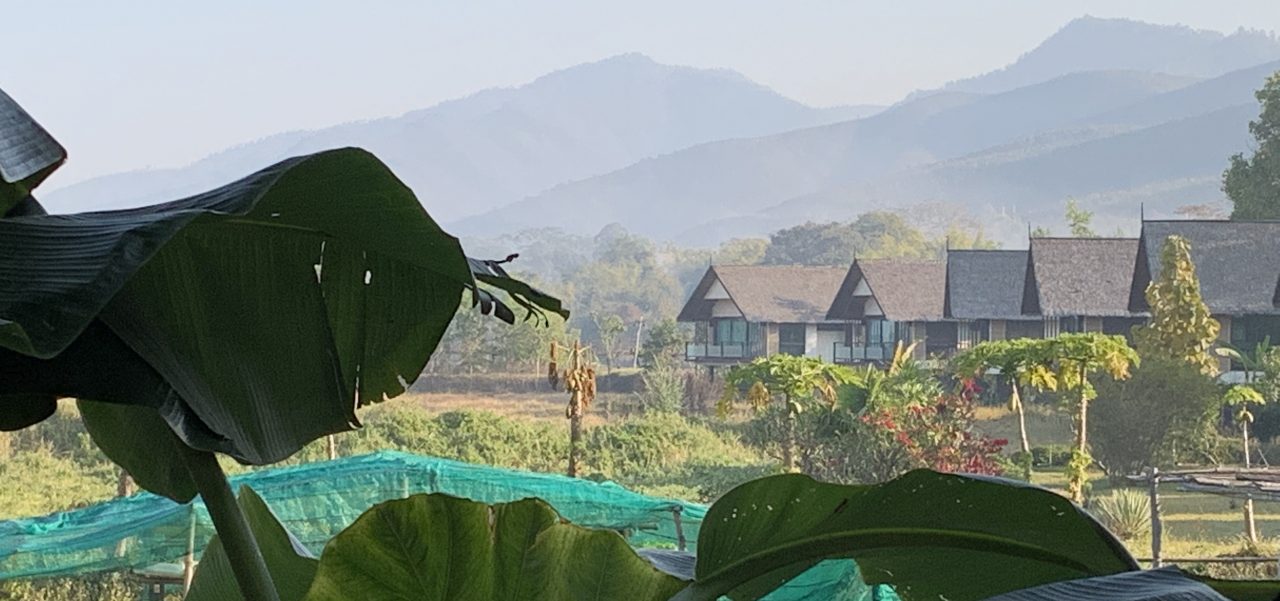
Naduang is a small farming village of about 800 people – equal numbers Lao and Khmu tribes – about 10 km outside of Vieng Vang.
ASEAN (Association of South East Asian Nations) sponsors a program of homestays in different towns in Laos as a way to promote understanding. In each designated town, several families volunteer to offer their homes and are trained and certified for homestays. Certified homes put up a wooden plaque with a number on it. The selected families designate a bedroom and make a European-style toilet available for visitors and provide sheets, towels. They also keep a guest book, the first page of which tells about their family and the remaining pages are for guests to leave notes at the end of the stay. The families typically speak very little English, but enjoy communicating with their guests in other ways.

We arrive and are assigned to the Phommabath family. The mother (mai), Singthong, meets us at the community center and takes us to her home – on the main street across from the elementary school. She and her husband, Bounchouk, are age 60 and have three children – two boys in their 20s and a 19-year-old daughter. They have a seven-year-old grandchild. Pictures of her family and her ancestors are hung on the walls.


We leave our shoes outside the house (as is standard practice for all buildings in Laos, whether religious or not). We are shown around the house, drop our overnight gear in the guest bedroom and then have time to sit on the front porch with a glass of water and share information with Ms. Singthong about our families as the sun sets. Across the street, a large group of village children of different ages play games in the schoolyard as the dusk sets in.


Ms. Singthong gets us dressed in traditional sarongs for dinner and at 7 pm we return to the community center for a group dinner and after-dinner dancing with our hosts – for which we have a lot of Laotian moves (with hands and hips – some sexy) to learn.


The morning comes early in Naduang. At 4:30 am the roosters start crowing – one rooster starts and the other village roosters take up the call (legend has it that the rooster calls on the sun to rise and calls again at the end of the day to tell it to set).

At 5:00 am the first smell of wood smoke appears in the air as the wood fires are lit for cooking. By 5:30, laundry is being hung on clotheslines, with the aid of a headlamp. As the sunrises, the smell of the Lao breakfast – grilled meat – adds to the smell of the woodsmoke.


By 8 am life is underway – children head to the elementary school, babies get washed, hair is cut streetside, men weave bamboo mats, rooster baskets and fish traps, and even give a thorough bath for a prize rooster (for the cockfighting that goes on in the evening).


All around we see unfinished homes. It takes 5 to 7 years to build a house. Villagers save up to buy materials — old style is bamboo posts and bamboo walls. These can be built by the individual with natural materials they harvest, and others in the village pitching in to help. Today most are build of concrete posts and concrete or brick and plaster walls with concrete floors. People save up to pour the foundation and erect the posts; save again to put up the walls, roof beams, and metal roof; and then save up for windows and the wooden front Buddha door. Around the village, work on new homes is halted at various stages of construction.

But overall, this town’s families seem content and hopeful for the future.

It’s time to say good-bye and thank our hosts for a great visit. We head down the road to Vang Vieng for a couple of days of fun..
