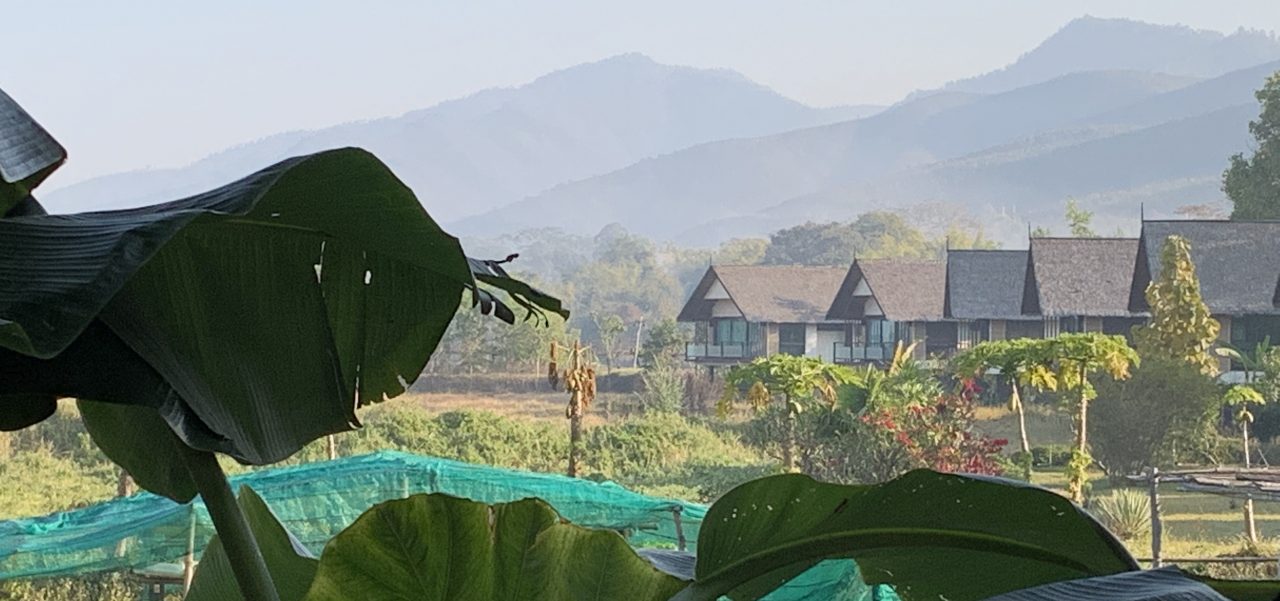

Vietnam is a Beautiful Country — Upon entering Vietnam, you are struck by the overwhelming beauty and lushness of its countryside. Every inch of agrarian land is used, and rich green rice paddies stretch as far as the eye can see, and run right up to the houses and roads — nothing seems wasted. Vietnam grows rice well — up to three crops a year in some areas…but it grows lots of other fruits and vegetables as well.


It’s people are beautiful – sometimes glamorous – and friendly as well.


Vietnamese seem to enjoy life – and they light everything up at night with brilliant colors: Hanoi’s Hoan Kiem Lake, Hue’s bridges and riverside boulevard, Hoi An’s Chinese-lanterned streets, boats floating in the river, and bridges, and Ho Chi Minh City’s streets.


And Vietnamese food is as good as it gets!! It’s essence is noodles — we know Pho (pronounced “fuh”), but there are lots of other kinds to discover, including Mi Quang and Cao Lao, the smoky thick yellow noodles. Then there is fish — Cha Ca, the fabulous sautéed turmeric catfish dish with noodles, greens and herbs that we had in Hanoi, and the coconut red snapper covered in herbs and wrapped in banana leaves in Hoi An. We can’t forget a good Banh Mi like the one from Banh Mi Phouang in Hoi An (recommended by Anthony Bourdain) – with lots of veggies and spices and super-fresh French bread… or the spring rolls in rice paper stuffed with fresh vegetables and herbs and dipped in fish sauce.
Vietnamese food just tastes fresh! What makes the food so special is the tricks to making a great Pho broth or fresh rice noodles; and the fresh, whole-plant herbs you throw in the bowl or wrap in rice paper.

Chinese influence — Vietnamese may not like or trust their northern next-door neighbor, but Chinese influence on Vietnamese culture is strong, particularly in Vietnam’s north. China ruled Vietnam for a thousand years until the 10th century, and there were always Chinese traders and merchants – with a strong presence in ports
Chinese influence can be seen in the number of old Confusion temples, Chinese-style architecture and furnishings, and the practice of Mahayana Buddhism (Vietnam’s neighbors in SE Asia all practice Theravada Buddhism which was brought to them from Sri Lanka and Nepal).
Another influence was writing in Chinese characters. Vietnamese was written with Chinese characters until a Portuguese missionary in the 17th century introduced a way to write Vietnamese in the Roman alphabet. The conversion to the Roman alphabet in the 20th century eliminated the need to memorize Chinese characters in order to read and increased literacy rates significantly.

Uniquely Vietnamese — Ancestor Worship – Also adopted from the Chinese is the Confucian practice of ancestor worship. Vietnamese venerate their ancestors, keeping a shrine in their home, and annually celebrating their immediate ancestors on the days of their deaths. Confucianism underlies much of Vietnamese custom and belief, regardless of religion.
Burial Practices — While other SE Asian nations cremate their dead and put their ashes in a stupa in a graveyard or near their home, Vietnam tradition is to bury the dead in above-ground coffins for two to three years, until the body is adequately de-composed, and then open the coffin, wash the bones to remove any flesh, and consolidate the bones to be reburied with other relatives in the family mausoleum.
Rural Vietnamese have typically buried their recently-deceased relatives in the middle of the rice fields to overlook the rice harvest. The government has been discouraging this practice and urging people to use community burial grounds or cremate their relatives. The practice is shifting to cremation, particularly with urban and younger generations.


Vietnam’s Population is Ethnically Homogenous — Unlike its western neighbor, Laos, Vietnam is not ethnically diverse. While Vietnam recognizes 54 different ethnic groups, 86 percent of the population is one ethnic group – Viet. All of the other groups have small numbers and live in Vietnam’s mountain regions.
Vietnam’s Population is Religiously Diverse — While 60 percent of the population identifies itself as Buddhist, an almost equally large group claim to follow a “folk religion.” As with Hindi mythology, folk religion practices may coexist with Buddhism. Christians are prominent in Vietnam, particularly in the South, but only 6 percent of the total population identifies itself as Christian – almost all Roman Catholic. However, increasingly, younger generations are shying away from organized religion.
Communism is Not a Substitute — The government of Vietnam is communist – a single-party state with a belief system that seeks to substitute for organized religion. The majority of the population are not engaged in politics — only 2 percent of Vietnamese are members of the communist party, and, therefore, eligible to hold office. National leadership is chosen by the Party, elections decide on who will fill local offices, but candidates must be party members. Younger people pay very little attention to politics.
Vietnam Knows War but Wants Peace and Prosperity — Over the last 2,000 years of its history, Vietnam has been at peace only 500 years. It has lived through occupations by the Chinese and French, civil wars, and has been an independent nation encompassing both south, central, and north for relatively short periods — during the Le Dynasty in the 15th and 16th centuries, and during the Nguyen dynasty in the 19th century before the French took over.
China ruled Vietnam for a thousand years until the 10th century when Vietnam took advantage of the collapse of the Tang dynasty to fight China for their independence. The Chinese seized control of Vietnam again in the early 15th century, but were beaten back by a Vietnamese liberator who established a Vietnamese Le Dynasty. Vietnam was divided between North and South for much of 17th and 18th centuries, until the Nguyen Dynasty was established at the beginning of the 19th century, bringing North and South together for a period that lasted through the end of World War II.
During this period, the French attacked Vietnam on a pretense in the 1850s and establish colonial rule that lasted until World War II when the Japanese occupied Indochina with French collaboration. As the war wound down, famine fueled by Japanese rice requisitions in this period contributed to the rise of the Viet Minh under Ho Chi Minh, which fought a war of independence against the French and halted their return to colonial rule with a military victory in 1954 at Dien Bien Phu.
A Geneva Conference negotiated new boundaries – dividing Vietnam into two separate nations at the 17th parallel. Ironically, in a country where roughly 60 percent of the population was Buddhist, the North was communist and the South was placed in the hands of the Catholic minority. Civil war broke out in the South as the local communists – the Viet Cong – backed by (and supplied by) the North – went to war with the U.S.-backed government. The U.S. escalated its presence until it became the American war, but by the early 70s pressure was on at home to negotiate a withdrawal, which the U.S. did in 1973, leaving the field open for the North to invade the South and re-unify the country under communism in 1975.
By 1979, Vietnam was at it again — invading Cambodia to protect its people from the ravages of its Mao-ist communist regime gone mad (more on this when we get to Cambodia). That caused China to attack Vietnam in a misguided effort to protect their ally the Cambodian regime. A Cambodian settlement was negotiated and Vietnam began a withdrawal in 1989. Finally, peace arrived with signing of the Paris Accords of 1991.
Post-War Hardship — The period after the communists re-unified Vietnam was a period of international isolation and significant hardship for the Vietnamese people. The American war had taken a huge toll on the population, disrupted the economy, destroyed a lot of the infrastructure, defoliated the forests, and left behind unexploded ordinance all over the country.
The communist rule was austere and harsh. South Vietnamese who had fought or worked on the government side or aided the Americans were sent off to re-education camps and had their property confiscated. Large numbers of them escaped and became refuges in other countries.
Those who were not punished by the government suffered through a long period of poverty. The communists set up farm communes that resulted in low rice yields. Nationalized factories that were dependent on Russia and the Eastern Europe for trade and foreign assistance suffered when Perestroika and the break up of the Soviet Union brought an end to Soviet commerce and aid, and brought Vietnam face-to-face with a potential economic disaster.
Peace, Prosperity, and Hope for the Future — In the 1990s, as peace returned, the Vietnamese government loosened its grip and sought to rejoin the community of nations. It relaxed investment restrictions and began to seek outside capital, it appeased the US and got their embargo removed and it joined the World Trade Organization in 2006. It has joined China and Laos as a communist nation with a freer-market economy, and has experienced a period of sustained economic growth with low unemployment.
Today, it exports machinery, computers, footwear, clothing, fish, coffee and tea, and rice. It has become the second-leading coffee producer in the world, producing both robusta and arabica beans, and, of course, its famous “weasel coffee,” made by feeding beans to weasels and recovering the beans from their poop to clean, roast, and make a great cup of coffee (I kid you not!)

On to Cambodia — Join us as we round out our tour of SE Asia in our fifth and last country, with stops in Phnom Penh and Siem Reap (Angkor Wat).
I think you should continue this blog when you return. I’d like to get this level of detail and commentary about D.C.