Final Reflections

We have had a spectacular trip and have enjoyed everything about it – on so many levels!

So, what did we really like about it?

1 – First and foremost, the people – It is a gross generalization, but we felt the people we encountered in the five countries we traveled in seemed generally respectful, appreciative, and modest. Frequently, people we encountered responded with an easy and ready smile.

In Myanmar in particular, but in the other countries as well, we felt a strong presence of Buddhism in people’s everyday lives. There is a certain humility about these people, they have a genuine appreciation for and respect for their older relatives, and go out of their way to help others. For many people, the concept of Karma (improving your prospects in the next life through the deeds you do in this life) is meaningful and influences their behavior. We also felt pretty safe, even when walking dark crowded streets at night.

2- Fresh food – when we went to a simple restaurant in Vietnam for a Banh Mi or a simple stir fry or noodle soup – there were piles of fresh herbs and vegetables to be added – making everything much more flavorful…and nutritious. Breakfast in the morning would start with an array of perfectly ripe, luscious fruit (mangoes, papayas, passion fruit, pineapple, dragon fruit, watermelon, banana). Even in some of the most remote and poorest areas, you can find a wide variety of seemingly- just-picked fruits and vegetables in the markets. Something we are hard-pressed to experience in our mass-produced, shipped and stored supermarket culture.

We also loved experiencing a range of new ingredients, spices and herbs, and flavors. There was particular creativity in the noodle dishes, and we came away with a new reverence for soups and the artistry of making a good broth (the secret of Pho). We encountered several dishes that were brilliant for freshness, flavor and balance and we were glad to have a chance to learn some of that art.

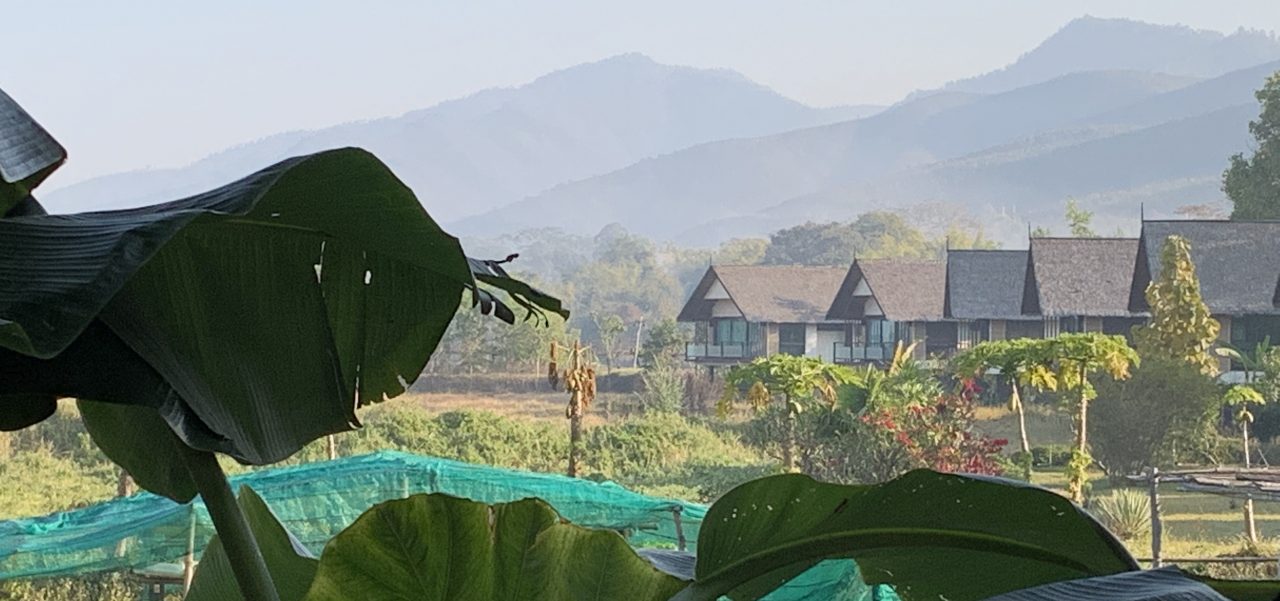
3 – Scenic Beauty — Great natural beauty: misty mountains, lush green rice paddies, stunning karsts, large flowing rivers, perfect sunsets.

4. Art and Architecture – From the teak temples and spectacular golden pagodas of Myanmar to the palaces and temple paintings of Vietnam, Cambodia, and Thailand to the bas reliefs in the Angkor temples to the tribal crafts of Laos, exquisite design and color was everywhere.

5. Laos – We get asked what our favorite country was. It is hard to single out one country, because each was special in its own way – but if we have to pick a favorite, it was Laos. Something about the people, the simplicity of life – as hard as it was for many Laotians, the importance of family and tribe, the effort to preserve of its diverse culture and crafts, and the rugged beauty of the country set it apart from the others. We realize, though, that all of that comes at a price for people – in remoteness, isolation, hardship and poverty. Economic growth and younger generations will bring change, and some of Lao’s culture and charm will diminish. We appreciated the ability to experience it still relatively unaffected by our modern fast-paced and consumption-driven global society.

6. – Our trip experience – we travelled with a great professional organization – G Adventures – with really wonderful tour leaders (Chit in Myanmar and Cat for the Indochina loop) and in a small group (12-16). G Adventures emphasizes individual contact with the culture and people and supports local projects in the communities they travel in through their foundation. We got to see and have meals at several of these organizations and appreciate the work they are doing to create opportunities for the younger generation.

Our Hope for Southeast Asia: Not one of these countries has a working democracy – people don’t like or respect their leaders — who are either unelected or “elected” through a rigged process. But they have been through far worse and are grateful for peace and the opportunity now to benefit from economic growth.

Laos and Cambodia are truly rural and poor. In Laos, the vast majority live in a tribal world in mountain communities where they live much as they have for centuries, relying on subsistence agriculture. There is a dignity to their way of life and it fits in a way with the social balkanization that naturally occurs in mountain regions. Cambodia lacks the natural beauty of Laos and also the access to natural resources. Rural life seems harsher and more difficult.

It has been almost 30 years since peace broke out in the region and the people who were responsible for the wars or who suffered the most are now either gone or old. The younger generations are not interested in the past or in the political baggage of their grandparents — they are looking to a better future.

The future for all of these countries is in their young populations and their investment in education. Some countries now mandate teaching English beginning in primary school for one reason — it broadens job opportunities in their own countries and links kids to the world through the Internet. The more these countries emerge from the dark ages of insularity and political repression and seek foreign investment and commerce for economic growth, the greater the hope for a more secure and prosperous future for the region.

These countries sit on great natural and historic resources that are at risk from over-exploitation. All are taking steps to better protect their forests, water, minerals, wildlife, and historic resources. More needs to be done. Necessity, local corruption and the Chinese thirst for electric power, raw materials, and new seaports already are overwhelming their best efforts at environmental protection and resource conservation.

Tourism is a major and growing source of income for the region, but it needs to be managed. Everywhere we saw huge developments (hotels, resorts, etc.) underway with Chinese and other outside investment. Large numbers of young people are learning language, hospitality and restaurant skills as the market expands.

The tourist experience for us was exceptional. We benefitted, due to the coronavirus outbreak this year, from a flow of tourists that was less than half of its usual level for the high season. In a normal year, though, the flow of tourists in the high season is dense and growing denser each year. The region will need to find a way to balance the appetite for tourist revenues with the need to preserve and protect the resources people are visiting or risk cheapening the experience as the tourist masses grow denser.

Thanks to all of our readers for taking this trip with us. These countries have so much to offer and we were grateful to experience and learn so much. We are impressed with and encouraged by the young people of this region who are driving the change that is so badly needed. We wish for them the best of all possible futures.

Cambodia – Angkor Thom and the Pink Temple

Within a few decades, the Cham attacked and sacked Angkor. The Cham were eventually conquered and incorporated into the Khmer Empire by Jayavarman VII, and much of Angkor was rebuilt. Jayavarman VII went on to build Angkor Thom (“Large City”)- a massive walled and moated city 9 square kilometer in size that is 1.7 kms north of the Angkor Wat complex. The city is surrounded by a moat 100 meters wide and a thick 8-meter-high stone wall. with four gateways in.

Entering Angkor Thom – The main entrance to the city is down a long causeway over a bridge that crosses the moat, and requires an entrant to the city to run the gauntlet between good and evil — between a row of 54 God’s heads on the left and a row of 54 Demons on the right — and through a gate under the watchful eyes of a large face over the entrance.

Gods
Demons
Infinite compassion and mercy watching over you.

The face over the gate, which appears again 4 times on each of the 54 towers in the Temple, is thought to represent Bodhisattva Avalokiteshvara — who is, in Mahayana Buddhism, the “Buddha-to-be” of infinite compassion and mercy. The face is believed to resemble Jayavarman VII, who saw himself as the incarnation of the Buddha, and built his own mausoleum/temple – the Bayon (as the French named it)— in the tradition of Mahayana Buddhism.

Bayon Temple — The Temple, built in the exact center of the city, features 54 towers, each with four large stone faces – identical to the face over the gate – aimed in the four directions — perhaps getting the point across to his Khmer subjects that their benevolent God-king had his eye on everything going on in the city. The significance of the number 54 is unknown – some suggest it may relate to the 54 provinces the King watched over in the Khmer Empire.

Bayon Temple
The faces on one of the many stone towers.

Most impressive feature of the Bayon Temple is the magnificent mural of bas relief carvings that goes around the outside of the wall on the first level. The carvings depict a variety of scenes from everyday life as well as the progress of the war with the Cham, including the sacking of Angkor in 1177 by the Cham forces, a naval battle in the Tanle Sap, and the routing and conquest of the Cham in 1181.

Preparing a meal
Dancers
Naval warfare

Angkor Thom – At its peak the city served nearly 1 million people. In addition to wooden houses and other buildings, the city included a lot of stone structures – the evidence of which remains today: many temples, a palace, reservoirs, and even 2 very large swimming pools – one for the King’s wives and concubines and the other for himself, and a stadium with a large oval track for games and celebrations, including elephant races and elephant fights.

The paltry remains of the Royal Palace
The large swimming pool was for the exclusive use of the many wives and about 4000 concubines.
The smaller pool was for the King’s exclusive use.
Phimeanakas Temple on the Royal Palace grounds
The Elephant Terrace upon which the King and Queen sat to watch the games and contests.
The King’s view of the fields for games and contests, showing the ramp down which the elephants were led for the elephant races and contests.

Ta Prohm — After the decline of the Khmer Empire in the late 14th century and the destruction of Angkor in 1431 by Siamese invaders, the Angkor area was abandoned and local people thereafter were too spooked to go near it. The crumbling temples were overrun through the centuries by the jungle, and by the time the French “discovered” them in the 1860s, they were clouded in mystery and covered in vines and trees.

Ta Prohm temple today still captures some of the feel of a lost temple emerging out of the jungle overgrowth (although it has been cleaned up quite a bit). Devotees of the movie Laura Croft: Tomb Raider flock here to see the setting that was filmed for part of that movie.

The Temple was built as a Buddhist temple and monastery to the king, in 1186 to honor Jaravarman VII’s mother. Today, the distinguishing feature for this temple is the artistry of the roots of the trees growing out of the temple ruins.

Entrance to Ta Prohm
A stone face embraced by some roots.
Our best efforts to guard the doorway through which Angelina Jolie fell in the movie: Laura Croft: Tomb Raider.
Scenes from life – different occupations.
What did they know about dinosaurs in the 12th Century

Banteay Srei – the Pink Temple – This temple is noteworthy for the pink sandstone that it was built with and the quality of the filigree carvings. The craftsmanship in the fine carving is unlike any other decorative work found in Angkor.

Banteay Srei is a small Hindu temple dedicated to the god Shiva, located 21 kms north of Angkor Thom. Built by a Brahmin (not a King) in the 10th Century, it predates the capital city itself by 200 years. We know this because carvings on the frame of the gateway to the temple grounds explain in Sanskrit and Old Khmer who sponsored the Temple and when it was built.

The temple is a marvel to behold. Each corner turned opens a new vista of remarkable carving. The most magnificent are carvings that tell stories from the Ramayana that are on the lintels over the doors. Banteay Srei is truly the jewel of the Angkor temples.

The concourse leading to the “Pink Temple”
Scenes from the Ramayana.
Decorations on one of the libraries.
Sanskrit text tells about the Temple builder and the date.

Epilogue – Like all great empires, the end eventually came for the Khmer Empire. The decline started in the 14th century with an outmigration of population from Angkor. Historians speculate that the building boom of the 12th and 13th centuries depleted resources — water, lumber and sandstone – and pushed the limits of the population (most of whom were compelled to work on the construction – an estimated workforce of 500,000 at one point). There was also prolonged drought in the region at that time. It became clear that the Khmer Empire was overextended and beginning to fray at the edges.

For Angkor, the end came when the Thai from Ayutthaya who had been subjects and mercenaries for the Khmer, marched on Angkor Thom in 1431 and sacked it, taking home as slaves many of the artisans, performers, and intelligentsia. People began migrating south to the village of Phnom Penh, which eventually became the capital for the Khmer. The area around Angkor was then abandoned until the mid-19th century when the French appeared and found the ruins of the once-great city,

The Future – The Siem Reap/Angkor area has become one of the leading tourist destinations in the world. Tourism to Cambodia has increased by 500 percent over the last 15 years — and tourists to Angkor Wat alone numbered 2.6 million a year by last count, more than half of these from China and neighboring SE Asia countries. Hotel and restaurant density in Siem Reap is heavy and growing fast. There are currently 280 hotels and resorts and over 150 restaurants in the immediate Siem Reap area, and 100 hotels under construction, many of these large cheap tourist hotels to meet the demand from Chinese tourists. Already locals complain that the concentration of tourists and tourist businesses are changing the character of both Siem Reap and the Angkor temples.

The huge drop off in tourism this year due to the coronavirus and Chinese cancellation of foreign travel made it possible for us to enjoy uncrowded Angkor treasurers at a leisurely pace without the overwhelming push of large tour groups. It is a tremendous economic hardship, however, for the region that depends heavily on tourist revenues. Keeping the tourist experience enjoyable for the tourists and manageable for those who are visited will be a major challenge as more of the world population develops the financial resources to satisfy their yen for travel.

Next and Final Post: Heading home: Reflections on the experience – what we most enjoyed and what we learned.

Cambodia – Angkor Wat

Angkor Wat is a massive Buddhist temple complex constructed as a Hindu Temple by the Khmer Empire in the 12th century. It is the largest Buddhist temple in the world, an architectural masterpiece, and a marvel of engineering that was declared a World Heritage Site by UNESCO in 1992.

Sunrise at Angkor Wat — We are up at 4:30 am to get tickets into Angkor Wat, walk along the access road and through the outer gates of the temple grounds, and get positioned to watch the sunrise come up behind the temple.

Angkor Wat — The temple complex occupies an area 2 kilometers square. At the outside edge of the complex is a huge 200-meter wide rectangular moat. Within that is a 4.5 meter high square outer wall that runs for 10 kilometers around the complex with a gate in the middle each side of the square. Within the outer wall is a rectangular complex surrounded by another wall that is 1 km x 0.8 km. Angkor Wat itself is located within this rectangle. The temple has a central tower that represents Mount Meru, home of the Hindu gods. Around it are arrayed four other lesser towers. In the center there are three terraces leading to the main tower.

Remnants of the moat that surrounds the complex.
Angkor Wat
The bas relief on the walls surrounding the inner enclosure depicting scenes from Hindu epic – the Ramayana.
Bas relief scene from the Hindu epic, the Ramayana. In the Ramayana, Rama and the Monkey army battle to win the return of Sita, Rama’s wife, from the Demon king who kidnapped her.
Stairs climbing up the mountain.
Spectacular high-relief carvings on the temple pillars.
More high-relief carvings.
A beatific smile.
Looking down from the third level into the temple.

The Origins of Angkor — Toward the end of the 8th Century AD, one of the several “mandala” (small kingdoms) that made up Cambodia and other parts of SE Asia began conquering and consolidating neighboring mandala to create the Khmer Empire. At that time, Hinduism or Brahmanism from India had spread through the region. The king took a Sanskrit name, Jayavarman II — “Jaya” for follower of Victory and “varman” for shield. He instituted the cult of the “God-King” and chose an area on the floodplain between the Kulen Hills and the Tonle Sap (Great Lake) for his palace and cult centers. His nephew Indravarman I initiated the construction on the site in 877 that would become a sprawling capital city and temple complex known in modern times as Angkor.

Construction began with the creation of a huge “baray” (reservoir) – 3.8 x 0.8 kms in size – that served a dual purpose of meeting irrigation and drinking water needs and mirroring the glory of the god-king. This was just the beginning of what ultimately became a vast and complex water-supply system created to meet the needs of a population of close to a million people. Indravaraman I also built the largest mausoleum/temple to date (800 x 500 meters) and the first built with stone instead of brick.

The Hindu Temple Angkor Wat – As the Khmer Empire expanded, the magnitude and magnificence of the temples grew apace. In 1119 AD, Suryavarman II started construction of a large pyramid-shaped temple/mausoleum devoted to the Hindu God Vishnu that we know today as Angkor Wat (“Capital Temple”).

Suryavarman II led a series of military campaigns against the Vietnamese and neighboring Cham kingdom. Scenes from these campaigns are featured in bas relief murals around the outside of the 3rd enclosure of Angkor Wat. In a last campaign against the Cham, the king was killed and his body never made it back to the mausoleum his subjects had built for his glory.

Scenes from Suryavarman II’s conquest of the Cham kingdom added after the death of the King.

Conversion to Buddhism — In the 13th century, Jayavarman VII, who saw himself as the incarnation of the Buddha, and had recently expelled the Cham from Angkor, built his own mausoleum/temple in the tradition of Mahayana Buddhism, in the city he created just north of Angkor Wat. At the same time, Angkor Wat was converted from a Hindu temple dedicated to Vishnu to a Buddhist temple. There are several Buddhist shrines that remain active for worshippers today.

A Buddhist shrine in Angkor Wat.

Next Up: Angkor Thom and the Pink Temple

Cambodia – Siem Reap

We head north, driving along the huge Tonle Sap, to Siem Reap and Angkor Wat. The trip north takes us back to the glory days of the Khmer Empire, when it reached from sea-to-sea including Siam (present day Thailand) on the Bay of Bengal and the Cham Kingdom (present day Vietnam) on the South China Sea.

Cambodian Countryside — The trip provides ample evidence of the need for infrastructure improvements. Roads are mostly two-lane and the passing often creates three lanes of traffic, which Cambodian drivers seem to handle without breaking a sweat, the passengers say their prayers. The roads are also tooth-rattling — with lots of potholes and portions torn up here and there for re-paving. Towns are dusty, with roadside shops and restaurants that crowd the highway.

The towns are dusty.
We pass several wedding preparations.

A common feature of rural Cambodia is the stilt house. There are a variety of explanations for why the stilt house is ubiquitous, including the benefits of shade and a draft in the hot climate – most people eat outside under the house — or as a way to keep snakes out of the house – or termites. The houses are built on teak or ironwood posts, and have stairs to the second floor where the bedrooms and kitchen are located.

The stilt house.

Most of the vehicles we see involve a motorcycle or other simple as the source of power, but rigged to add so much more to the package.

How much can you pull with a motorcycle?
Very common form of tractor. A simple tiller engine and a steerable axle.

Another feature of a trip through rural Cambodia is the range of food options. Lots of traditional curries, stir-fries, and noodle soups. But also some food items we don’t find other places:

Our roadside lunch spot has plenty of options already cooked.
The insect market offers more: Nicely-spiced grubs…
…and crispy-fried tarantulas!

Siem Reap — The town of Siem Reap has developed as a major destination in its role as the entry point for the temple complex at Angkor, which includes Angkor Wat and the city of Angkor (Angkor Thom). More on the historic sites, later.

Siem Reap itself is a series of dusty streets that are relatively by day, with a bar-restaurant-night market center that comes alive at night. The bulk of the population is either serving or selling to tourists, or is tourists.

But it has some good Khmer food!

Pub Street
Date night dinner at Khmer Kitchen.

Next: Angkor and Angkor Wat

Cambodia – The Killing Fields

I am calling this the Killing Fields because this is the way most Americans know about what happened here. I am not doing a travel blog on this day – I took only two photographs – only of memorials – out of respect for the victims. Rather I want to reflect on what I learned – what this means to us – and what we should all be concerned about for the future.

First: A Simple Version of a Complex Story —After World War II, the French tried to reassert their control over French Indochina and were defeated by the Viet Minh at Dien Bien Phu, negotiating their withdrawal at the Geneva Conference in 1954. This left four independent nations with no stable governance and an Indochinese communist party on the move with 3 branches: Viet Minh, Pathet Lao, and Khmer Rouge.

The Rise of the Khmer Rouge: In Cambodia, the French-endorsed King (Sihanouk) abdicated in favor of his father and formed a socialist party that won elections, creating a father-son King and Prime Minister. With a royalist regime firmly in place, the leftists were driven out of Phnom Penh and retreated to the forests. While the Viet Minh followed the Russian path, the Khmer Rouge followed the Maoist model toward an agrarian utopia – they took up the cause of the farmers and over time strengthened their hold on the rural areas under their leader Pol Pot (an assumed name – short for “political potential”). They preached a message targeting the educated elite as “enemies of the people” and promising to improve life for the peasants.

In the 1960s, the U.S. stepped into the Vietnam civil war on the side of South Vietnam and launched a secret war in Cambodia that included heavy bombing of large parts of the country. Sihanouk tried to play a neutral role – aligning with the North Vietnamese, and allowing the Russians and Chinese to ship supplies to the Viet Cong across Cambodia.

In 1970, one of Sihanouk’s generals, Lon Nol, deposed him while he was on a visit to North Korea. Sihanouk allied with Pol Pot to fight Lon Nol, and built widespread support for the Khmer Rouge in the population.

When the US withdrew from SE Asia after the Paris Accords, the North Vietnamese crossed the 17th parallel and entered Saigon in April 1975. At the same time, the Khmer Rouge entered Phnom Penh.

The Pol Pot Regime: At first they were welcomed, but within days it became clear that a tough new Maoist regime had taken over. The hard core of the Khmer Rouge arrived in town and started rounding up the Lon Nol people and the educated elite. The calendar was reset at Year Zero – the beginning of a new era. Phnom Penh was emptied out, as institutions (government offices, monasteries, schools, hospitals) were closed, government officials and professionals were arrested, and the rest of the urban population was sent out to various rural regions and given jobs on the farms. Buddhism, education, health care, money, and other essential institutions were eliminated, schools, hospitals, or other empty buildings were converted to prisons or government use. Even Buddhist monks were sent to work in the fields in forced labor gangs.

The regime set up a system of oppression and cruelty masked by euphemisms and set about eliminating everyone with an education or who resisted the regime. People were taken from their homes and sent to “Re-education Centers” [prisons] for interrogations. Once their re-education was complete, they might be selected to go to a “Training Center” for a new job [the killing fields] where they would be brutally slain and thrown in an open pit. The regime operated 196 prisons and 343 killing fields.

Monument at Tuol Sleng Security Prison (S-21) to the 17,000 who were imprisoned here and were tortured and killed.

Those who were not killed in the killing fields died of starvation. In the forced labor camps, workers got a bowl of rice porridge (basically starch-thickened water) in the morning and another at night. Workers worked from sunrise to sunset. Families were broken up — men, women, and children were housed separately in the camps.
Interrogations were used to root out anyone with an education for “re-education.” Individuals detained would be asked for detailed information on all family members including distant relatives that could be used to identify anyone with education, a skill, or a talent. If you gave false information you would be tortured until you gave the answers they wanted. If you gave them what they wanted, your reward would be go on to the “Training Center.”

Memorial at Choeung Ek for the 8,895 victims brutally murdered at this “killing field.”

The Vietnamese Invasion: Slowly the population was starving to death. The Vietnamese invaded Cambodia in 1979 and quickly routed Pol Pot and the Khmer Rouge, who disappeared into the forests to continue a guerrilla campaign.

When the smoke cleared on 5 years of Pol Pot’s rule, 3 million of Cambodia’s 1975 population of 7 million were dead (half from starvation and half from the killing fields), development was stymied and the economy was gutted — having lost all but 15% of its educated and skilled workforce.

The Paris Accords of 1991 worked out an agreement among all parties that remains in place today. The Vietnamese left, Sihanouk was re-instated as King, with a democratically-elected National Assembly that returns the communist Khmer Rouge (now called the People’s Democratic Party) to power every 5 years in fraudulent elections. The government declared a general amnesty in 1998, and today, some of those serving in government positions are people who had senior positions in the Pol Pot regime. Five people were singled out to be skapegoated for war crimes. Today only one of those cases has resulted in an imprisonment

What does this all mean for us? — Cambodia’s experience with vicious and cruel despotism is a particularly important lesson for us in our current political situation. We think this kind of experience is far away from us, but it is not. It can happen to us and the warning signs are already firmly in place. Look for the parallels:

Tyrants are simple-minded people who find a weak vein in society and cleverly exploit it for their own glory and gain. The time to stop them is before they can build momentum, because once their mechanism is in place, people are not only afraid to take action, but the apparatus is set up to expose them and strike them down if they talk about it. In Cambodia, no one could risk talking to anyone else (especially children and spouses) for fear that they would get hauled in for an interrogation.

The success of a tyrant is built on first targeting a population subgroup as “enemies of the people,” and then inciting the rest of the population to hate them and take action against them. Pol Pot made anyone educated an “enemy of the people.” He created his following among the rural and uneducated poor who resented the power of the elite and the neglect the elite had shown for their plight. In doing this, he also hamstrung any resistance — anyone who came forward with a contrary view or statement of fact would be, by definition, educated and would be arrested. It also helped Pol Pot fill his ranks of followers and soldiers with children, teenagers, and the uneducated who could be easily trained to hate and be vicious and cruel. Young people were chosen as executioners and those executioners who showed any hesitation or remorse were killed.

Revolutions eventually burn themselves out because those who are loyal to the leader start killing each other off as more and more of them fail the increasingly high bar of the Tyrant’s personal loyalty test. But not before they reap a lot of destruction. In Cambodia, huge numbers of party and military leaders were purged and killed. Pol Pot eventually turned on and killed his top leadership and closest associates, many of whom had been classmates of his in school.

The damage that is done to a society is devastating and long-lasting. The Pol Pot regime gutted Cambodia’s skilled workforce and destroyed its economy. Despite the fact that this happened more than 40 years ago, the scars are visible today. Since then, the population has grown from 4 million to 16 million — most of these still quite young. Very few remain who lived through this time, yet a pall remaining from this episode hangs over the economy and the people. Cambodia is underdeveloped relative to its neighbors, and the mood we sense from the population seems more one of resignation to their situation than energy to bring change for a better future. We can only hope that Cambodia’s young people will turn this around.

Cambodia — Phnom Penh

We cross the border into Cambodia, a country of 16 million people, 90 percent of whom are Khmer, with a small minority who are Chinese or Cham (Muslim Khmer).

Governance — Cambodia today is ruled by a King and a “democratically-elected” National Assembly that has been controlled by the communists (Cambodian People’s Party – the old Khmer Rouge) for 25 years. In effect, it is a communist country with a King.

The King, Norodom Shamoni, the son of the previous king Sihanouk (on-and-off king since 1941) is head of state. The Prime Minister, Hum Sen, is “head of government” and has been in this position since taking over in a bloody coup in 1998. Popular elections every 5 years are never in doubt, and all of the executive, legislative, and judicial functions of government are under Hun Sen’s control.

The flag – with Angkor Wat on it.
Cambodian leadership – King Norodom Shamoni and Prime Minister Hun Sen.

First Impressions — Our initial impression entering Cambodia is how dry it is. We see huge rice fields that are brown and barren – a stark contrast to the lush greens we just saw in Vietnam.

The reason is that much of Cambodia is flat – almost a bowl shape with hilly areas near its borders – with a natural watering mechanism – the huge Tonle Sap (“Great Lake”) in the center of the bowl – that fills with water from the Mekong River in the rainy season and pumps water back into the Mekong in the dry season. A lot of Cambodia is not fertile soil, but the areas around the Lake that are fertile come to life when the rains arrive and dry out by the end of the dry season. While Vietnam gets in up to 3 rice plantings a year, Cambodia gets only one.

This year the dry season has been unusually dry – so Tonle Sap has drawn well away from its banks and the surrounding area is just brown. Chinese damming of the Mekong River and lack of environmental protections in Cambodia will make water even more scarce in the coming years.

Tourism – Another difference this year is the absence of Chinese tourists due to the coronavirus outbreak. The Chinese are viewed as both a blessing and a curse in SE Asia. The blessing is they come in mass and spend plenty of money as tourists. They account for a large portion of the tourist revenue here. The curse is that they come in mass.

Due to the effects of the coronavirus this year, Chinese tourism is SE Asia is non-existent and tourism overall is down significantly because European and American tourists are cancelling plans to tour Asia. Our guide in Angkor Wat told us that they usually have 7 to 8,000 tourists a day in peak season — this year they have only about a thousand a day, and this number is dropping. We have enjoyed seeing the sights without the usual masses of tourists, but we worry that it is a huge economic blow to the region that will have lasting effects for these developing countries.

Phnom Penh – This was a sleepy town on the Mekong River before the French arrived in the mid-1800s and made it their colonial capital. Once regarded as “the Pearl of Asia,” Phnom Penh today is a faded remnant of that glamorous past. It is a city that is busy, but not that busy, glamorous in spots, but just developing fancy high rises and trying to pull out of the long slump Cambodia has been in. It is a city of great potential, yet to be realized.

Tuk-Tuk, the preferred mode of travel in Phnom Penh.
Crush of motorcycles and Tuk-Tuks on the sidewalk and wherever,
Waiting for business
Promenade along the Mekong

Food — Cambodia’s traditional specialities are: Fish Amok – fish, lemongrass, coconut milk, turmeric, and chili served in a banana leaf; and Beef Lok Lak, slices of beef stir fried with onions and tomatoes, and served with an egg. Cambodian cuisine tends to be mild and needs a side order of sliced hot pepper and soy sauce to spice it up.

We stop for lunch at Friends, the Restaurant, near the Royal Palace. Friends is a highly regarded Phnom Penh restaurant that is part of the Tree-Alliance of SE Asia restaurants the provide their profits to support training underprivileged kids in the restaurant business, and providing experience in the restaurants for these kids. It is a great program supported by GAdventures, and the food is fantastic!

Chicken Stir Fry with Mango, Cashew Nut and Chive Flowers, plus a Lemongrass Lime Ginger Iced Tea with Honey at Friends (the Restaurant) — an organization that supports training for underprivileged youth in the hospitality and restaurant business. Great food and drink!!

Royal Palace and Silver Pagoda — The Palace grounds are quite large and accommodate spacious gardens and several buildings. Within the grounds are a walled off area with the King’s residence that is off-limits to tourists. The rest of the grounds include a large Throne Hall – a large open hall for official receptions with the King’s golden throne at one end (photography not permitted inside) — a banquet hall, a royal treasury, and the Silver Pagoda.

The Palace and surrounding building were built in the 1890s and early 1900s. They are fine examples of the classic Khmer roof style that makes Cambodian architecture distinctive.

The Throne Hall
Gazing in the window at a Royal Drum in the Throne Hall.
The King’s Residence — the Blue Royal Flag indicates that the King is in residence.
How do you get on an elephant if you are a King? White Elephants have special meaning in Buddhism – the Khmer kings hoarded them.

The Silver Pagoda gets its name from the 5,000 solid silver tiles that make up its floor (also not allowing interior photos). It is officially the Wat Prea Keo (Pagoda of the Emerald Buddha). The pagoda was originally built as a wood building in 1892. The present building is the result of a rebuild in 1962.

The Silver Pagoda
Young monks visiting the Silver Pagoda
A small section a mural depicting one event from the Hindu Sanskrit epic of the Ramayana painted on the inside of wall surrounding the Silver Pagoda.

Wat Phnom — This is a prominent pagoda placed on top of the only hill in town and linked to the name of the town. Legend has it that the first temple was built on this spot in 1372 to house 4 Buddha statues floating down the Mekong the were deposited on this hill and discovered by Lady Penh. The city gets its name that means “Hill of Penh” from this temple. The current temple is the result of a rebuild in 1926.

The Temple
A mural includes scenes from Cambodian mythology.
The stupa that is a prominent feature of the Phnom Penh skyline.

An Evening Cruise on the Mekong – We have nice evening for a cruise on the river – to enjoy the breeze and watch the sunset.

Evening near the confluence of the Mekong and Tonle Sap Rivers.
Rapid development of a tourist area along the river.
Sunset behind the grounds of the Royal Palace.
The light show in the new tourist area.

Traditional Cambodian Dance— We are glad we get to see a small group of dancers perform several traditional dances and folk dances from Khmer culture. Some of these dances incorporate the hand and foot positions seen in the carvings of dancers in the temples at Angkor — they date to the time of the Khmer Empire, and most likely before. They are the images we had of Cambodia from our childhoods.

The folk dances are lively performances that relate to the interplay between young men and women in their teen years and include a lot of light joshing and humor around the day-to-day work of fishing, growing rice, and preparing food. Great fun to watch.

Traditional Cambodian dance
Traditional Cambodian dance with precise hand and foot positions.
Traditional story of the princess who holds the ball with the power and overcomes attempts by the demon to steal it.
Coconut Dance — a folk dance that is traditional way for young people to mingle.

Next: Lessons from “Killing Fields”